Indian River Steamboats and the Era of the Lagoon, 1880 to 1920
Before the railroad reached the lagoon coast, steamboats moved citrus, pineapples, and tourists up and down the Indian River. Two dozen vessels at peak. The railroad ended them in a decade.
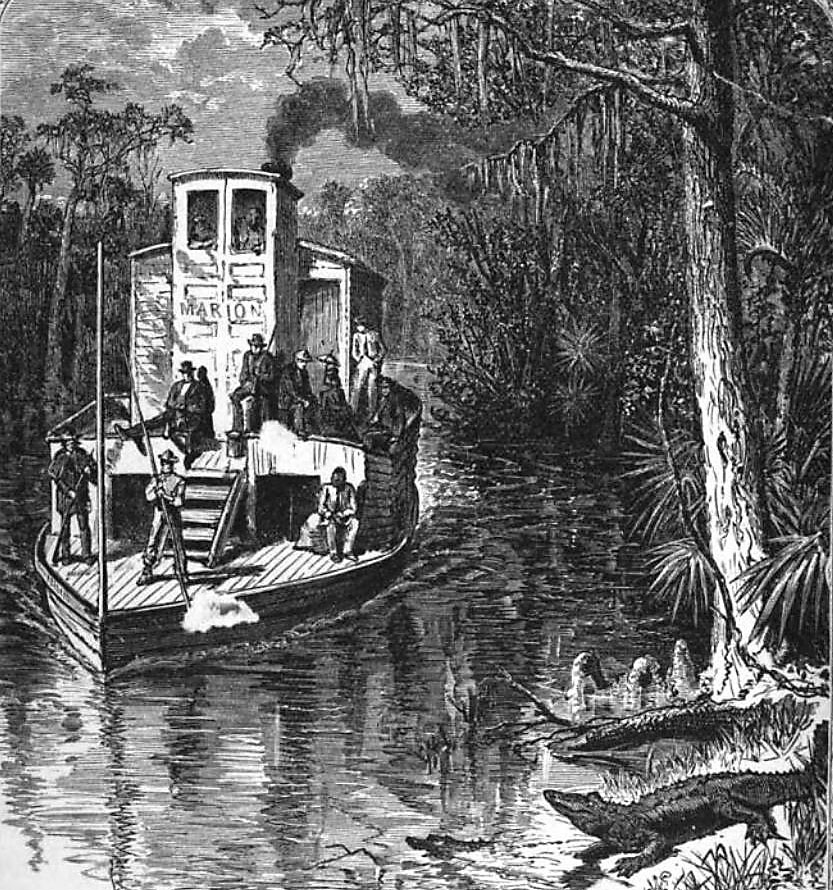
For about forty years, the Indian River Lagoon was a highway. Steamboats running shallow draft and high gunwales worked the lagoon between Titusville and Jupiter Inlet, carrying citrus boxes, pineapple crates, mail, freight, and passengers from one wooden dock to the next. The fleet peaked around 1888 at roughly two dozen vessels. By 1903 the Indian River Steamboat Company was bankrupt, and the railroad had taken everything.
The era is short enough that primary sources are usable. Captain’s logs, dock receipts, freight manifests, and the company’s own corporate papers survive in the Florida Historical Society archives. The single best secondary source is Edward Mueller’s 1989 Steamboats and Sailing Ships on the Indian River, which compiles vessel-by-vessel histories from those primary materials.
Why steamboats worked on the lagoon
The Indian River is brackish, shallow, and largely sheltered. The lagoon runs roughly 156 miles north-south behind the barrier islands, with depths averaging 4 to 8 feet outside the dredged channels. A purpose-built shallow-draft sidewheeler or sternwheeler could work most of it without grounding. The trade winds and afternoon thunderstorms made sailing the lagoon hard for square-rigged vessels, the wind shifts too often and the storms hit too fast, but a steamboat could push through both.
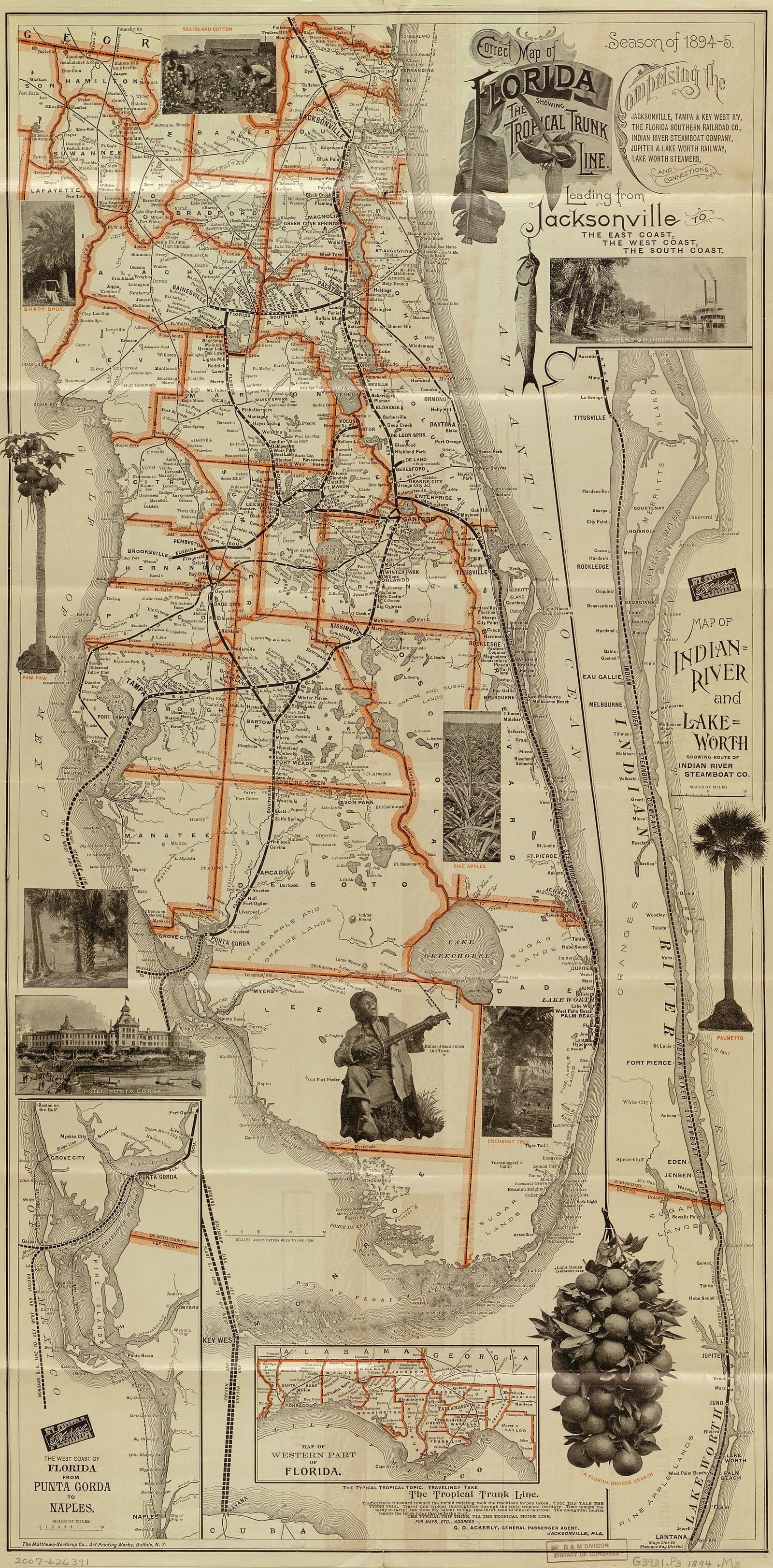
What the lagoon lacked was inlets. The only reliable connection to the Atlantic during the early steamboat era was the Jupiter Inlet at the south end, with smaller and frequently silted-shut inlets at Sebastian, Fort Pierce, and Indian River. Goods coming north by ocean ship had to transload at Jupiter onto a lagoon steamer. Goods going south reversed the process. Titusville at the north end connected to rail (the Jacksonville, Tampa and Key West Railway reached Titusville in 1885), so the typical freight pattern ran north-to-south: rail to Titusville, steamer south to Cocoa, Rockledge, Eau Gallie, Melbourne, Sebastian, and finally Jupiter.
The fleet
The Indian River Steamboat Company was the dominant operator. Its principal vessels included the Rockledge, the St. Augustine, the St. Sebastian, the Cinderella, the Sweeney, and the Cuba. Sizes ranged from about 80 feet to 140 feet length overall. Most were sternwheelers built for low draft, with cabins on the upper deck for passengers and open cargo deck below.
Smaller independents worked alongside the company fleet. Captain James Pritchard’s Sebastian, the Sams family vessels out of Eau Gallie, the LaRoche packet boats, these handled local routes between specific docks, often on irregular schedules. The fleet was not centrally controlled. A grove owner in Rockledge could load citrus onto whichever boat was at his dock, often a small independent rather than the company’s main packet.
Total fleet count varied year by year. Mueller’s compilation lists 28 distinct vessels in regular service between 1880 and 1900, with overlapping construction and retirement cycles producing roughly 16 to 22 in operation at any one time during peak years.
What they carried
Citrus, in season, was the largest single tonnage. The 1888-89 season saw the Indian River steamboat fleet move approximately 250,000 boxes of oranges between the lagoon-coast packing houses and the Titusville rail terminus, according to the Indian River Steamboat Company’s annual report cited by Mueller. Each box ran roughly 90 pounds gross weight. Total citrus tonnage that season was on the order of 10,000 short tons.
Pineapples grew rapidly through the 1890s. Lagoon-coast plantations at Eden, Eldred, Ankona, and Sebastian shipped pineapples specifically because the steamboats could handle them with less damage than wagon transport over the sand roads. By 1898 the lagoon-coast pineapple crop reached approximately 75,000 crates a season.
Mail, paying a federal contract, was the reliable baseline freight. Tourists were the high-margin freight, especially during the winter resort season at the Rockledge hotels and the Eau Gallie hotels. The Rockledge steamboat ran daily during winter season at peak, with one-way fare from Titusville to Rockledge of $1.50 (1890 dollars) and from Titusville to Jupiter of $7.
What killed them
The Florida East Coast Railway extension. The FEC reached Rockledge in February 1893, Eau Gallie and Melbourne in November 1894, Fort Pierce later in 1894, and the full line through to Miami in 1896. Once a grove owner in Eau Gallie could load citrus directly onto a boxcar a hundred feet from his packing house, the steamboat was obsolete for freight. The economics did not work. Rail freight to New York ran four days. Steamboat-plus-rail freight ran six to nine. Spoilage on the slower route ate the price premium for first-arrival fruit.
The Indian River Steamboat Company filed for bankruptcy in 1903. The bankruptcy sale dispersed the fleet. The Rockledge was sold to a Mississippi River operator. The Cinderella burned at her dock in Cocoa in 1904. The St. Sebastian was hauled onto land near Sebastian and used as a dance hall before being torn down around 1920.
Passenger service hung on a few years longer than freight. The Sweeney ran intermittent winter runs through 1908. By 1910 the lagoon was effectively a recreational waterway, used by yachts, fishing boats, and the occasional commercial barge, not scheduled steamboat service.
The docks
The dock infrastructure outlasted the boats by a decade or two. Photographs from Florida Memory show steamboat docks at LaGrange, Titusville, City Point, Cocoa, Rockledge, Eau Gallie, Melbourne, Sebastian, and Fort Pierce surviving into the 1920s in identifiable form, mostly as fishing piers or freight transfer points for small boats. Most were torn down between 1925 and 1945 for navigation channel dredging, hurricane damage, or simple rot.
A few traces survive. The Cocoa Village waterfront still has a few pilings from the 1890s steamboat dock visible at low tide, near where the modern marina sits. The Eau Gallie waterfront retains some original 1890s seawalls. Florida Memory’s photographic record is the best surviving documentation.
The captains
The steamboat captains were a distinct social class on the lagoon coast through the 1880s and 1890s. Names that show up repeatedly in the records: Captain Steven Bravo of the Cinderella, Captain James Pritchard of the Sebastian, Captain Burnham of the Rockledge, Captain Sams of the Two Sisters. They served as informal postal carriers, freight agents, town gossip distributors, and occasional rescuers when somebody capsized a small boat in the lagoon. Several married into prominent Brevard families and stayed on as merchants or grove owners after the steamboats died.
The most famous Indian River captain, James Pritchard, became a substantial Titusville merchant after the steamboat era and gave his name to the Pritchard House, the prominent Italianate Victorian still standing at 424 South Washington Avenue in Titusville. Pritchard’s papers are at the Brevard County Historical Commission archives.
What the era looks like in retrospect
Forty years is a short run. The Indian River steamboats existed because of a specific gap in infrastructure: the lagoon coast had producers and demand but no rail connection to northern markets. When the rail filled that gap, the steamboat economy collapsed within a decade, more or less on schedule.
The lasting effect of the steamboat era was that it bootstrapped the lagoon coast’s settlement. Without the steamboats moving people, mail, citrus, and pineapples in the 1880s, the population that justified extending the FEC south through Brevard would not have been there. The railroad killed the steamboats, but the steamboats had built the towns the railroad came to serve. The two depend on each other in a tight chain that compressed into about twenty years between roughly 1880 and 1900, and that chain set the geography of every coastal community in Brevard for the next century.
Further Reading
As an Amazon Associate we earn from qualifying purchases.