The Florida East Coast Railroad Reaches Brevard, 1885 to 1894
Henry Flagler's railroad reached Daytona in 1889, Titusville in 1885 (under predecessor lines), and pushed south through Cocoa, Eau Gallie, and Melbourne by 1894. It rewrote the lagoon coast's economy in a decade.
Henry Morrison Flagler did not build the first railroad into Brevard County. He bought it. The Jacksonville, Tampa and Key West Railway and the Jacksonville, St. Augustine and Halifax River Railway already reached Titusville by 1885, when Flagler was still primarily a hotel-builder rolling the profits from Standard Oil into Florida real estate. What Flagler did, between his consolidation of those predecessor lines in 1892 and the push to Miami in 1896, was extend the network south through the entire Indian River coast and rewire the local economy in a decade.
Before the railroad, Brevard moved on water. After the railroad, the steamboats were obsolete within five years.
The predecessor lines
Two short railroads served Brevard County in the early 1880s. The Jacksonville, Tampa and Key West Railway, despite its ambitious name, ran from Jacksonville south to a terminus at Titusville, reached in 1885. The other, the South Florida Railroad, ran inland through Orlando and Kissimmee toward Tampa, never touching the lagoon coast.
The Titusville terminus mattered because Titusville was the head of the Indian River steamboat network. Steamboats moved citrus, pineapples, and tourists up and down the lagoon between Titusville and Jupiter Inlet, with stops at Cocoa, Rockledge, Eau Gallie, Melbourne, and Sebastian. A passenger from New York could reach Titusville by rail in two days, board a steamboat at the FEC dock, and be in Cocoa or Melbourne by evening. The lagoon coast was effectively the Riviera of the Northeast for a brief decade in the 1880s.
The system worked, but it was fragile. The river silted. Storms shut it down for weeks. The steamboats were small and the freight capacity limited. Citrus growers south of Titusville paid double the freight rates of growers along the rail line, and the wait for a steamboat in season could mean fruit rotting on the dock.
Flagler’s purchase and the southward push
Flagler bought the Jacksonville, St. Augustine and Halifax River Railway in 1885, primarily as a feeder for his St. Augustine hotels. Over the next seven years he bought, leased, or built every short line between Jacksonville and Daytona Beach. In 1892 he consolidated them under a new name, the Florida East Coast Railway, and announced the company’s intent to push the line south to the lagoon coast and beyond.
The extension came in pieces. The line reached Rockledge in February 1893, Eau Gallie and Melbourne in November 1894, Fort Pierce in 1894, Palm Beach in 1894, and finally Miami on April 22, 1896. Henry Bradley Plant, Flagler’s primary railroad rival on the west coast, watched the FEC eat his northeast Florida market and never managed to extend east himself.
The construction was not dramatic. The terrain was flat sand and pine flatwoods, the longest bridges were over the Sebastian and St. Lucie inlets, and the labor was a mix of Black contract workers from south Florida and seasonal northern crews. The line ran on the west side of the Indian River through most of Brevard, hugging the mainland because the barrier-island side had no settled population to serve.
What changed was speed and capacity. A boxcar of citrus from Cocoa could reach New York in four days by rail in 1894. The same boxcar had taken nine days by combined steamboat and rail through Titusville in 1890, and three weeks by ship around Cape Florida in 1885.
What it did to the local economy
The freight rates tell the story. Citrus shipping rates from Rockledge dropped roughly 40 percent between 1892 and 1895, according to Florida Citrus Exchange figures cited by Seth Bramson. The steamboat fleet, which had numbered roughly two dozen vessels at peak in 1888, was down to four or five by 1900. The Indian River Steamboat Company filed for bankruptcy in 1903.
Pineapples, which had been a marginal Brevard crop because the steamboat handling damaged the fruit, became viable. By the mid-1890s, Eau Gallie, Melbourne, and Sebastian shipped tens of thousands of crates a season. The crop collapsed within twenty years for unrelated reasons (Cuban competition, a 1908 freeze), but the railroad was the enabling infrastructure that allowed it to scale at all.
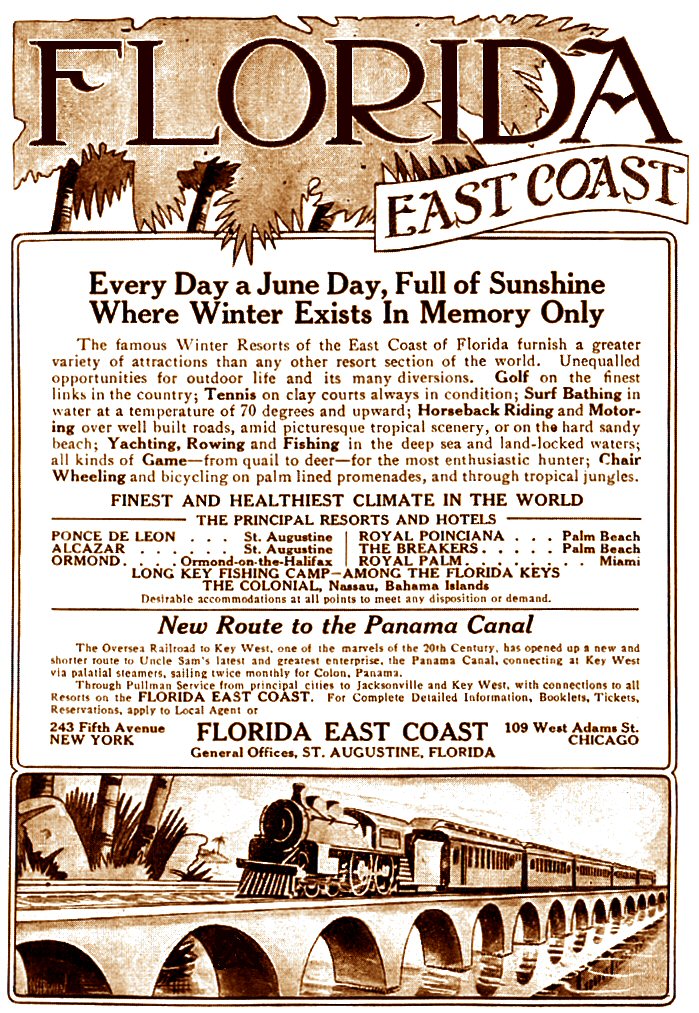
The hotel economy shifted south. Flagler built the Hotel Royal Poinciana in Palm Beach in 1894 and the Breakers in 1896, both fed by the new rail line. The Indian River steamboat-fed hotels in Cocoa, Rockledge, and Eau Gallie that had been the resort district of the 1880s shifted to a more local clientele or closed entirely. The Hotel Plaza in Rockledge, the largest in Brevard during the 1880s, was demolished in 1962 after decades of decline.
Tourism along the lagoon never came back to its 1880s peak in real terms. Palm Beach, Miami, and later Boca Raton drew the wealthy winter trade. Brevard became a freight-and-agriculture county rather than a tourist destination, until the space program transformed it again in the 1950s.
The 1894-95 freezes complicate things
Two back-to-back freezes in December 1894 and February 1895 wiped out the citrus belt across central and north Florida. Growers in Marion, Lake, and Orange counties lost 70 to 90 percent of their trees. Brevard, sitting farther south and protected by the lagoon’s thermal mass, fared better but still lost roughly half its grove acreage.
The combination of the FEC reaching the lagoon coast and the 1894-95 freeze pushing growers south created a brief boom in Brevard citrus through the late 1890s and early 1900s. Acreage doubled between 1895 and 1900 in the Cocoa-Rockledge area. The freeze of 1962 ended that long arc, and the 1989 freeze drove the final packing houses out.
Henry Flagler, briefly
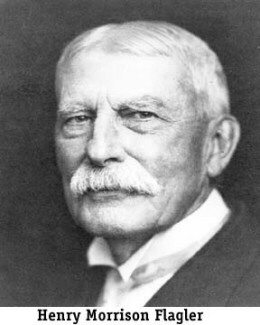
Flagler was born in Hopewell, New York, on January 2, 1830. He partnered with John D. Rockefeller in the Standard Oil Company in 1870, the year of its formal incorporation. By 1882 the company had a national monopoly. By 1885 Flagler had retired from active management and turned his attention to Florida, eventually investing roughly $50 million (1900 dollars) into railroads and hotels along the east coast.
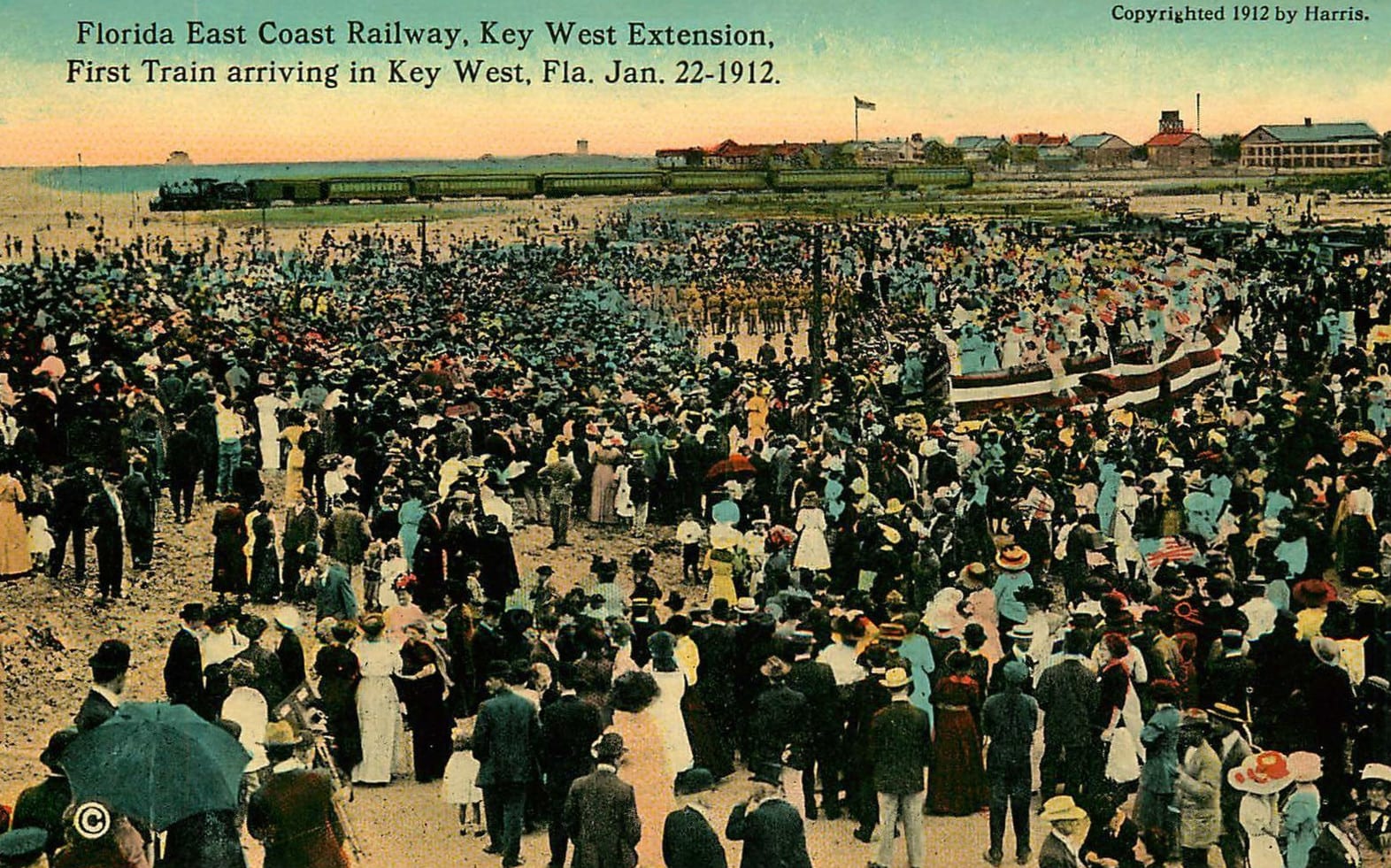
He died in West Palm Beach on May 20, 1913, three years after the FEC completed the Overseas Railroad to Key West (which the 1935 hurricane destroyed). His estate, the Flagler Museum in Palm Beach, holds the corporate archive and remains the primary source for FEC business history.
What the railroad left
The rail line is still there. The FEC, now owned by Mexico’s Grupo México Transportes, still runs freight through Brevard along essentially the original alignment. The Brightline passenger service that began running through Brevard in 2024 uses the same tracks. Titusville, Cocoa, Eau Gallie, and Melbourne all still have rail stations on the original sites, though none are passenger stations in regular use.
The hotel landscape is gone. The Royal Poinciana burned down in 1925. The Hotel Indian River in Rockledge, the Hotel Magnolia in Cocoa, the Hotel Carleton in Melbourne, all demolished or converted to other uses by 1970. The only Flagler-era hotel surviving in any form in Brevard is the Casino Building in Rockledge, now a private residence.
The steamboat docks were rotted out by 1920. The cargo books survived in the FEC archive. The 1885-1894 decade, the brief overlap when the lagoon coast had both steamboats and rail, ran the place richer than anything before or after it for the next sixty years. Then the rocket program landed in 1950, and the railroad became infrastructure rather than the economic driver. That’s another story, on another track.
Further Reading
As an Amazon Associate we earn from qualifying purchases.