The 1973 Oil Crisis and Brevard's Space-Program Layoffs
Apollo wound down through 1972. The 1973 oil embargo hit a Brevard economy already reeling from the post-Apollo aerospace contraction. Unemployment exceeded 15 percent in 1974.
Brevard County entered 1972 with approximately 32,000 aerospace and related jobs. By 1976 the number was approximately 14,000. The 18,000-job loss over four years produced the worst single-county economic contraction in Florida’s modern history, and the 1973-74 oil crisis hit the middle of that contraction, compounding the local pain with national recession and consumer-price shock.
The combination is the underlying story of Brevard in the 1970s. The space-program layoffs were the bigger long-term hit. The oil crisis was the punch that turned the layoff cycle into a sustained crisis.
The post-Apollo contraction
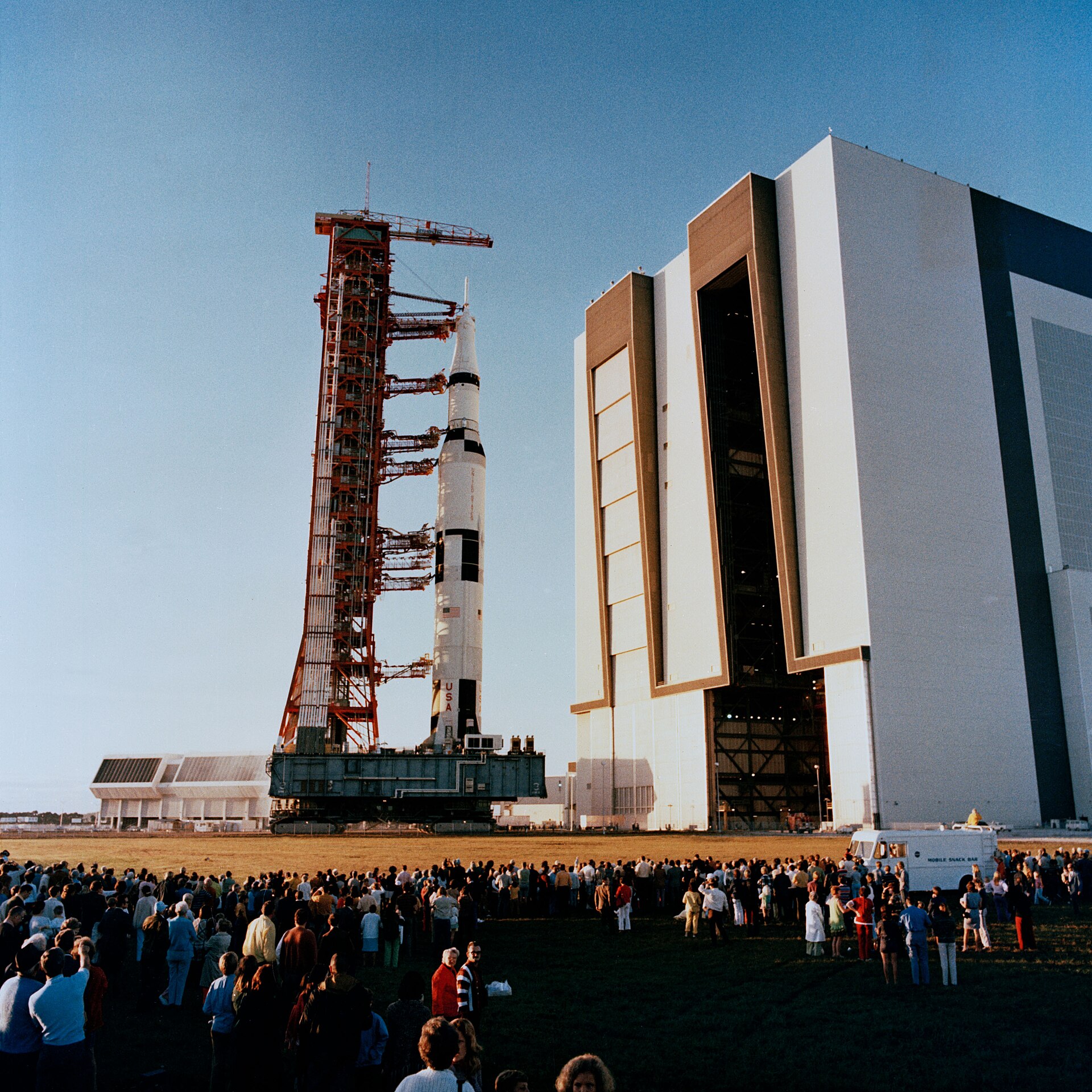
The Apollo program ended on December 19, 1972, with the splashdown of Apollo 17. NASA’s workforce planning had anticipated a substantial post-Apollo reduction, but the actual reductions came faster and deeper than the formal planning had projected.
NASA’s Kennedy Space Center workforce dropped from 26,500 in 1968 to roughly 21,000 in 1971 to 16,500 in 1973 to under 13,000 by 1976. The reductions were almost entirely on the contractor side; the federal civil service workforce stayed roughly constant at 2,500-3,000 throughout the period.
The contractors that absorbed the cuts included Boeing (Apollo Stage I), North American (Apollo Command and Service Modules), Grumman (Apollo Lunar Module), IBM (Apollo guidance computers), Bendix (mission control software), and dozens of smaller subcontractors. Boeing’s KSC workforce alone dropped from approximately 6,500 in 1968 to under 1,500 by 1975. The Saturn rocket production line at the Michoud facility in Louisiana shut down entirely in 1973. The Lunar Module production at Grumman’s Bethpage, New York facility wound down through 1972.
The Brevard workforce impact concentrated in skilled technical positions. Engineers, technicians, quality assurance specialists, machinists, and skilled trades workers comprised approximately 70 percent of the layoffs. The clerical and administrative cuts were smaller in absolute terms but proportionally similar.
The 1973 oil crisis hits
OPEC instituted an oil embargo against the United States on October 17, 1973, in retaliation for US support for Israel during the Yom Kippur War. Domestic oil prices roughly quadrupled between October 1973 and January 1974. Gasoline shortages produced rationing systems, hour-long lines at gas stations, and reduced retail and consumer-discretionary spending across the US.
The recession that followed (officially November 1973 through March 1975) was the deepest US economic contraction between WWII and the 2008 financial crisis. National unemployment peaked at 9 percent in May 1975. Inflation reached 12 percent in late 1974. Consumer spending dropped sharply.
For Brevard, the oil crisis arrived in the middle of an existing local crisis. The aerospace workforce contraction had already produced approximately 12,000 job losses by October 1973. The oil embargo and the broader recession added an additional 6,000-8,000 job losses through 1974-75 across retail, construction, real estate, food service, tourism, and other consumer-facing industries.
The unemployment numbers
Brevard County unemployment data from the Bureau of Labor Statistics shows the full impact:
- 1968 (Apollo peak): unemployment approximately 2.5 percent
- 1971: approximately 5 percent
- 1973 (start of oil crisis): approximately 8.5 percent
- 1974: approximately 13.5 percent
- 1975: approximately 15.5 percent (peak)
- 1976: approximately 12 percent
- 1978: approximately 8 percent
The 1975 peak unemployment of approximately 15.5 percent was approximately double the national rate (9 percent peak in May 1975). Brevard’s specific exposure to aerospace contracting combined with the broader recession produced a localized depression-level unemployment situation.
The unemployment numbers undercount the actual workforce impact for several reasons:
- Many laid-off aerospace workers relocated to Houston, Huntsville, Los Angeles, and other aerospace centers and were not counted in Brevard unemployment data.
- Many displaced workers transitioned to lower-paying jobs (often at 40-60 percent of their previous aerospace wages) but were not counted as unemployed.
- Many older displaced workers took early retirement or accepted disability designations rather than seeking re-employment.
The true workforce displacement, including all these categories, probably affected roughly 25,000-30,000 Brevard workers between 1969 and 1976.
The housing market crash
Brevard’s residential real estate market crashed in parallel with the workforce contraction. Houses in Cocoa Beach, Titusville, and Cape Canaveral that had peaked at approximately $35,000-50,000 in 1969 dropped to $20,000-30,000 in 1972-1974. Several large subdivisions, particularly in Palm Bay and West Melbourne, sat half-built for years.
The General Development Corporation, the largest land developer in Brevard during the 1960s, declared bankruptcy in 1975. The bankruptcy left thousands of lot purchasers, many of whom had made down payments on lots in undeveloped GDC subdivisions in Palm Bay, with substantial financial losses. The eventual GDC bankruptcy resolution in 1981-1983 returned roughly 60 cents on the dollar to lot purchasers but produced years of stalled development in the affected subdivisions.
Foreclosures spiked. Brevard mortgage default rates in 1974-1975 ran at approximately 4-5 percent of all outstanding mortgages, roughly five times the national rate. Bank holdings of repossessed houses concentrated in Cocoa Beach, Cape Canaveral, and the newer Palm Bay subdivisions. Several local savings and loan institutions were absorbed by larger Florida banks in the post-crisis consolidation.
Tourism and retail impact
The Cocoa Beach tourist economy, built around 1960s motel construction for launch-spectator and beach traffic, contracted sharply. Approximately 30 percent of Cocoa Beach motel inventory was closed between 1971 and 1975, either temporarily or permanently. Several Cocoa Beach restaurants and tourist-oriented retail businesses closed permanently.
The Walt Disney World theme park, which opened in Orlando in October 1971, paradoxically helped Brevard’s tourism economy through the recession by drawing Disney visitors east to the beaches and to Port Canaveral. The new SR 528 expressway (the Bee Line, completed in stages 1959-1976) made the Disney-to-Cocoa Beach drive routine. Brevard tourism revenue did not collapse to the extent the housing market did, partly because of the Disney spillover.
Education and re-employment
The University of Central Florida (then Florida Technological University, opened in Orlando in 1968) and Florida Institute of Technology in Melbourne both expanded substantially through the 1970s, partly to absorb displaced aerospace workers seeking re-credentialing for other industries. Brevard Community College (now Eastern Florida State College) also expanded through this period.
Many former NASA contractors transitioned to non-aerospace engineering work, particularly in civil engineering (Florida’s rapid 1970s growth produced substantial road, sewer, and water projects), in healthcare (Brevard’s hospital system expanded significantly through the 1970s), and in education (former aerospace technicians often became technology and trade-school teachers). The transition was disruptive at the individual level but produced a more diversified Brevard workforce by the early 1980s than had existed at the Apollo peak.
The shuttle reprieve
The Space Shuttle program, announced in 1972 and finally producing operational launches from KSC in 1981, began to rebuild the Brevard aerospace workforce through the late 1970s. By 1980 KSC employment had climbed back to approximately 14,500. The 1986 Challenger disaster temporarily contracted the workforce again, and the post-2003 Columbia disaster and post-2011 Shuttle retirement produced similar but smaller contractions.
The post-2015 commercial space buildout (SpaceX, Blue Origin) has restored most of the long-term aerospace workforce by 2024 to approximately 16,000 jobs. Brevard’s specific lessons from the 1973-76 cycle, the danger of single-industry concentration, the value of educational infrastructure for re-credentialing, the importance of diversification, have shaped the county’s economic development strategy ever since.
What the 1970s left
The 1969-76 contraction produced the institutional memory that still shapes Brevard’s economic decision-making. Local officials, business leaders, and homeowner associations all carry the experience of watching the Apollo workforce evaporate. The county’s caution about over-concentrating in single industries, its emphasis on tourism and healthcare alongside aerospace, and its insistence on infrastructure that serves multiple purposes (not just NASA-specific facilities) all trace to the 1970s shock.
What the period also produced was a hardened resignation about the aerospace boom-and-bust pattern. Every subsequent space-program transition has been absorbed by a Brevard community that knows the cycle. The 2011-2015 post-Shuttle gap, smaller than the 1971-76 gap in absolute terms but similar in proportional impact, was managed with substantially more institutional preparation: re-employment programs in place from day one, federal transition assistance funded in advance, local educational infrastructure ready to absorb displaced workers.
The 1970s were the lesson. The subsequent cycles have been the practice. Whether Brevard will face another cycle as deep as 1971-76, and how well the local economy will absorb it, is the open question for the 2030s and beyond.
Further Reading
As an Amazon Associate we earn from qualifying purchases.