The 1894-95 Great Freeze and Brevard Citrus
Two freezes in eight weeks ended the citrus belt north of Brevard. Growers moved south. For 70 years Brevard was a citrus county, until the 1962 freeze and Cuban competition did to it what the 1894 freezes had done farther north.
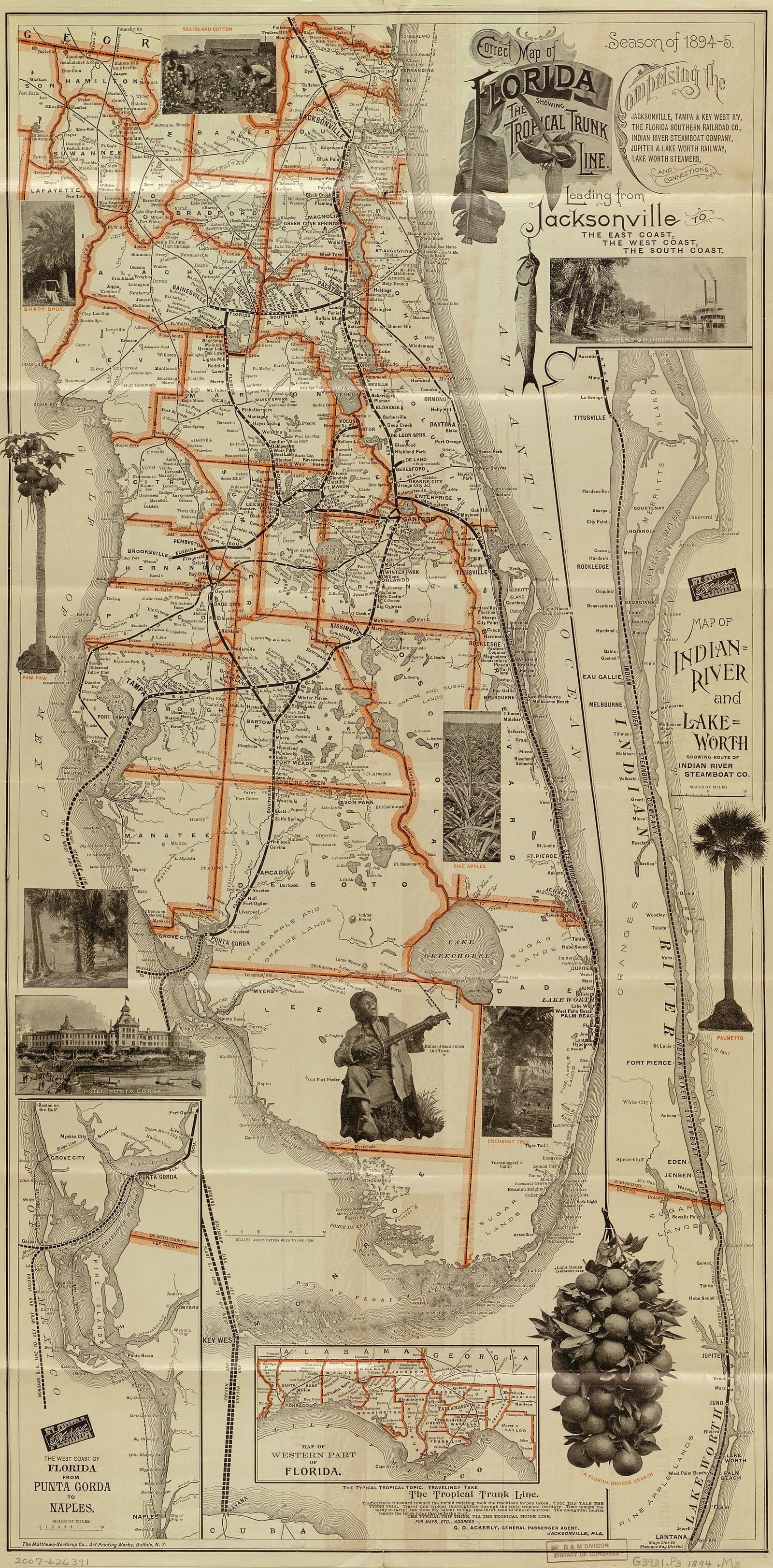
The first freeze hit on December 28, 1894. Temperatures dropped to 18°F in Jacksonville, 24°F in Orlando, low 30s as far south as Cocoa. Growers across the Florida citrus belt lost the fruit on the trees and most of the year’s leaves. The trees themselves survived, mostly. The industry talked itself into believing it had escaped the worst, replanted what was needed, and waited for spring.
The second freeze hit February 8, 1895. The temperature in Tampa dropped to 19°F. Polk County reported 14°F at sunrise. The new leaves and the bark on the still-recovering trees froze solid. When the spring sun hit the trunks, the bark split. Within a week, hundreds of thousands of trees across central Florida were dead at the root.
That second freeze ended the citrus belt north of Brevard for a generation.
The numbers
USDA records put the Florida citrus crop at 5.5 million boxes in the 1893-94 season. After the freeze, the 1895-96 crop was 75,000 boxes. Florida did not match its 1893-94 production until 1909, fourteen years later. Acreage records compiled by Florida Citrus Mutual show roughly 70 to 90 percent tree mortality across Marion, Lake, Volusia, and Orange counties. Some northern groves never replanted; the land went to truck farming, then suburbs.
Brevard fared better. Lagoon thermal mass, latitude (most of Brevard’s growing area sits below 28.5°N), and proximity to the moderating Atlantic kept temperatures four to seven degrees warmer than central Florida during both freeze events. Brevard County records, summarized in Robinson’s 1949 Florida Citrus History, show roughly 40 percent grove damage and tree survival above 60 percent. Titusville and the northern Indian River groves, sitting at the climate zone’s edge, lost a higher fraction than the Cocoa area groves further downriver.
That was enough to make Brevard the new northern frontier of viable citrus.
The southward migration
Through 1895 and 1896, growers who had lost everything in central Florida bought land in Brevard, St. Lucie, and what is now Indian River County. The Florida East Coast Railway had reached Cocoa in February 1893, Eau Gallie and Melbourne in November 1894, just before the freeze. The freight infrastructure was in place. The land was cheap, $5 to $25 an acre for raw scrub.
Brevard grove acreage roughly doubled between 1895 and 1900, from about 4,000 acres to over 8,000. By 1910 it exceeded 15,000 acres. The packing houses followed: Cocoa, Rockledge, Eau Gallie, Melbourne, Sebastian (then in Brevard, after 1925 in Indian River County). The 1909-1915 period was Brevard’s citrus peak by both acreage and infrastructure count.
The cultivars planted in this wave reflected the lesson of 1894-95. Growers favored sour orange rootstock, which proved more freeze-tolerant than the sweet seedling stock that had dominated central Florida. They favored the Pineapple orange and the Valencia, both better-keeping varieties that could ride out a shipping delay if a freeze did hit. They built rail-served packing houses rather than river-served ones, ending the steamboat era within a decade.
The 1962 freeze, and why it mattered differently
Brevard’s citrus held through the freezes of 1899, 1934, 1947, and 1957, all damaging, none ending. The December 1962 freeze was different. Temperatures in Cocoa dropped to 22°F. Inland Brevard groves at Mims, Scottsmoor, and Cocoa-area west of the railroad lost 60 to 80 percent of their trees. The coastal groves, protected by the lagoon, held better.
But the 1962 freeze hit a citrus industry already under pressure from three other directions: Cuban citrus imports had collapsed after the 1960 embargo and US growers had over-expanded to fill the gap; the space program had pushed Brevard land values up sharply (a grove acre that sold for $400 in 1955 was selling for $4,000 by 1965); and Mediterranean fruit fly and citrus canker quarantines were ratcheting up costs.
Many Brevard growers, especially those near the launch area, took the 1962 freeze as a signal to sell. The land was worth more as housing for KSC employees than as freshly replanted grove. The 1989 freeze, which hit Brevard hard (temperatures in Titusville reached 17°F on December 23-24), finished off the remaining commercial groves. The last large Brevard packing house, Indian River Citrus League in Mims, closed operations in the mid-1990s.
By 2000, citrus in Brevard was essentially a hobbyist and U-pick endeavor. Acreage was below 1,500. By 2020, with citrus greening (HLB disease) on top of the climate and economic pressures, even the U-pick operations were closing.
The grafted varieties that remember the freezes
A few Brevard cultivars trace directly to the 1894-95 selection pressure. The Pineapple orange, propagated heavily after 1895 because it ripened earlier (before the December freeze window), is still grown in small quantities. The Hamlin orange, which ripens in October-November, became a Brevard specialty in the post-1895 wave for the same reason.
Sour orange rootstock dominated the post-1895 Brevard plantings and is still the rootstock of choice for any grower replanting today, despite the HLB pressure. The reasoning has not changed. Sour orange handles cold better than sweet, and the lagoon coast still gets the occasional freeze.
What the 1894-95 freezes meant for the regional economy
The freezes did not destroy Florida citrus. They redistributed it. The center of gravity shifted south by roughly 80 miles, from the Marion-Lake-Volusia line to the Brevard-St. Lucie line. Polk County, sitting between the old belt and the new, absorbed a wave of growers between 1895 and 1910 and remains the largest citrus-producing county in Florida today.
For Brevard specifically, the freezes set up the seventy-year run of citrus dominance that ended with the 1962 freeze and the space program. The grove rows that the railroad opened in 1894-1895 fed the regional economy through both world wars, the Depression, and the postwar housing boom. The grove acreage being sold off in the 1960s to NASA contractors was, in many cases, the same land first planted after the 1895 freeze.
The freeze records are now important again for a different reason. The 1894-95 events came at the end of a cold cycle in the Atlantic Multidecadal Oscillation. Recent NOAA modeling suggests Florida is entering a similar cold cycle now, after roughly forty years of relatively mild winters. The infrastructure is gone. The expertise is gone. If a 1895-class freeze hits the remaining Indian River grapefruit growers in the next decade, they will face the same calculation Brevard growers faced in 1962 with the same answer.
The Orlando 18-degree record that still stands
The cold of December 28, 1894 was extreme by any standard. Orlando reached 18°F that morning, an all-time record low that has not been broken in the 130 years since. The February 9, 1895 event drove West Palm Beach to 27°F, also a record at the time. The snowstorm that accompanied the December event dropped roughly 20 inches of snow on Houston, the heaviest accumulation in that city’s history. Snow fell as far south as Tampico, Mexico, within the Tropic of Cancer, marking the lowest latitude where sea-level snowfall has been recorded in North America.
The temperature gradient between the December and February events tells the underlying story. The December event was a deep cold push that killed fruit and leaves. The February event was a hard freeze that struck after a January thaw had restarted sap flow in damaged trees. Many growers had taken the January warmth as a recovery signal, pruned damaged branches, and were preparing for spring when the February freeze locked in the kill. The bark on the warming trunks split when the cold returned. The thaw-freeze sequence, not the absolute December cold, is what destroyed the trees.
The southward migration in numbers
Florida citrus production figures from the years immediately after the freeze make the regional shift visible. The 1893-94 statewide crop was roughly 5.5 million boxes. The 1895-96 crop, after both freeze events, was 75,000 boxes. State-level production did not match 1893-94 levels again until 1909, fourteen years later. By the time the recovery happened, the geographic center of production had shifted south by roughly 80 miles, from the Marion-Lake-Volusia line to the Brevard-St. Lucie-Polk band.
Land values collapsed in the old citrus belt and rose in the new. A grove acre in Marion County selling for $1,000 in 1893 was selling for $10 in 1896. A scrub acre in southern Brevard or in what would become Indian River County, selling for $5 in 1893, was selling for $25 to $40 by 1900 as displaced growers competed for plantable ground. Earnestville in Volusia County, a citrus town with roughly 200 residents before the freeze, was effectively abandoned by 1898 and is no longer on the map.
The Florida East Coast Railway carried the migration. The FEC had reached Cocoa at mile 173 from Jacksonville in February 1893 and pushed south to Eau Gallie (mile 190) and Melbourne (mile 194) by November 1894, just weeks before the December freeze hit. The freight cars that had been moving fruit north from the new Indian River groves were available to move displaced growers south in 1895-96. Julia Tuttle famously sent Henry Flagler an orange blossom from her unaffected Miami grove after the February freeze, which historians credit as a factor in his decision to extend the FEC to Miami by 1896. The freeze did not just redistribute citrus. It rewrote Florida’s transportation map.
The grafted-tree lesson the industry remembered
The post-1895 replanting wave produced one durable technical change: nearly universal adoption of sour orange rootstock for grafted sweet orange and grapefruit varieties. Sour orange tolerates cold better than sweet seedling stock by about 5°F, enough to make the difference between a killed tree and a damaged-but-recoverable tree in a marginal freeze. Pre-1895 Florida citrus had been a mix of sour orange grafts, sweet seedling stock, and a handful of trifoliate orange experiments. After 1895, sour orange dominated. Even the post-1962 and post-1989 Brevard replantings used sour orange.
The same rootstock has now become a liability. The HLB-causing bacterium Candidatus Liberibacter asiaticus, the cause of citrus greening, attacks sour orange rootstock particularly aggressively. The Indian River grapefruit industry that still depends on sour-orange grafted trees is more vulnerable to HLB than the California production that uses different rootstock varieties. The 1895 lesson protected the industry against another century of freezes and left it badly positioned against a disease that did not exist in Florida at the time of the choice. The technical decisions made in the years after a single catastrophe shape the industry’s vulnerability profile for a century afterward.
Further Reading
As an Amazon Associate we earn from qualifying purchases.